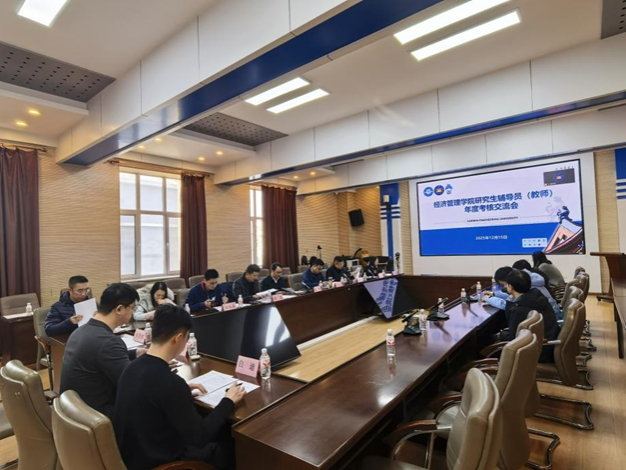
To further strengthen the construction of the graduate student counselor (teacher) team, improve the cultivation mechanism and incentive policies, and establish a regular mechanism for discussing education work, the School of Economics and Management recently organized the 2025 annual assessment meeting for graduate student counselors (teachers) and the work exchange meeting for young mentors. CHEN Heng, Dean of the School of Economics and Management; YU Yunliang, Party Secretary of the School of Economics and Management; HOU Lei, Vice Dean of the Graduate School; YANG Ximiao, Deputy Party Secretary of the School of Economics and Management; heads of all grassroots academic organizations; WU Haoge, Secretary of the Youth League Committee; graduate student counselors (teachers); and graduate student representatives attended the meeting. The meeting was presided over by LIU Tiansen, Vice Dean of the School of Economics and Management.
First, Vice Dean of the School of Economics and Management LIU Tiansen introduced the background of the graduate student counselor (teacher) assessment work and the management methods for graduate student counselors, emphasized the significance of the assessment work, and elaborated in detail on the job responsibilities and requirements of graduate student counselors (teachers).
In the debriefing and exchange session for graduate student counselors (teachers), all counselors systematically organized and presented their work over the past year around six aspects: ideological and political education and value guidance, graduate education management, graduate Party, Youth League and class construction, tutor-led ideological and political education, development of graduate academic quality, and cultivation of graduate innovation capabilities.
Vice Dean of the Graduate School HOU Lei pointed out that the position of graduate student counselor (teacher) is not only a practical platform for young mentors to temper their abilities and accumulate experience, but also an important link connecting the university, the School, and graduate students. He systematically clarified the “four roles” that young mentors should play in the growth of graduate students: the “navigator” of ideological guidance, the “booster” of academic research, the “guardian” of growth and talent development, and the “whistleblower” of safety and stability. He also put forward specific suggestions and work requirements for further strengthening the role of the graduate student counselor (teacher) team.
Dean of the School of Economics and Management CHEN Heng emphasized the special value of the graduate student counselor (teacher) team in frontline education practice, affirmed the efforts of all teachers in going deep into the student group, guiding ideological development, and setting a positive example over the past year, and put forward three expectations for future work: First, adhere to taking root among students, deepen organizational leadership, and carry out guidance and demonstration based on the practical accumulation of frontline work, so that education measures better meet student needs. Second, base work on the full process of education, strengthen identity cognition, deeply understand the connotation of work with the responsibility of teachers, and continuously improve understanding of the essence of education through reflection. Third, seize growth opportunities, enhance professional capabilities, and inject strength into improving the quality and efficiency of graduate education management through careful observation, accurate analysis, timely feedback, and systematic summarization.
Party Secretary of the School of Economics and Management YU Yunliang made a concluding speech, pointing out that graduate student counselors (teachers) should clarify their role positioning, strengthen responsibility awareness, and attach great importance to their own capacity building, guiding young mentors to deeply grasp the connotation of their “four roles”. At the same time, it is necessary to refine work measures, consolidate the foundation for performing duties, strengthen linkage and collaboration with grassroots academic organizations by clarifying job responsibilities, building exchange platforms, and exploring paths to improve efficiency, and ensure that management services accurately meet student needs. It is essential to improve the guarantee mechanism, stimulate team vitality, and further improve incentive and support mechanisms to fully release the educational advantages of the graduate student counselor (teacher) team, laying a solid foundation for implementing the fundamental task of fostering virtue through education and improving the quality of graduate training.
This annual assessment meeting for graduate student counselors (teachers) and work exchange meeting for young mentors not only systematically reviewed the achievements and shortcomings of the School’s graduate education work, but also built a learning and exchange platform for showcasing achievements, mutual learning, and common improvement, further strengthening educational consensus and stimulating team vitality. In the next step, the School will continue to promote the professionalization and scientific development of the counselor team, improve evaluation and support mechanisms, promote the in-depth integration of ideological and political education and academic guidance, and continuously enhance the effectiveness of graduate education.





 Homepage
 中文
中文